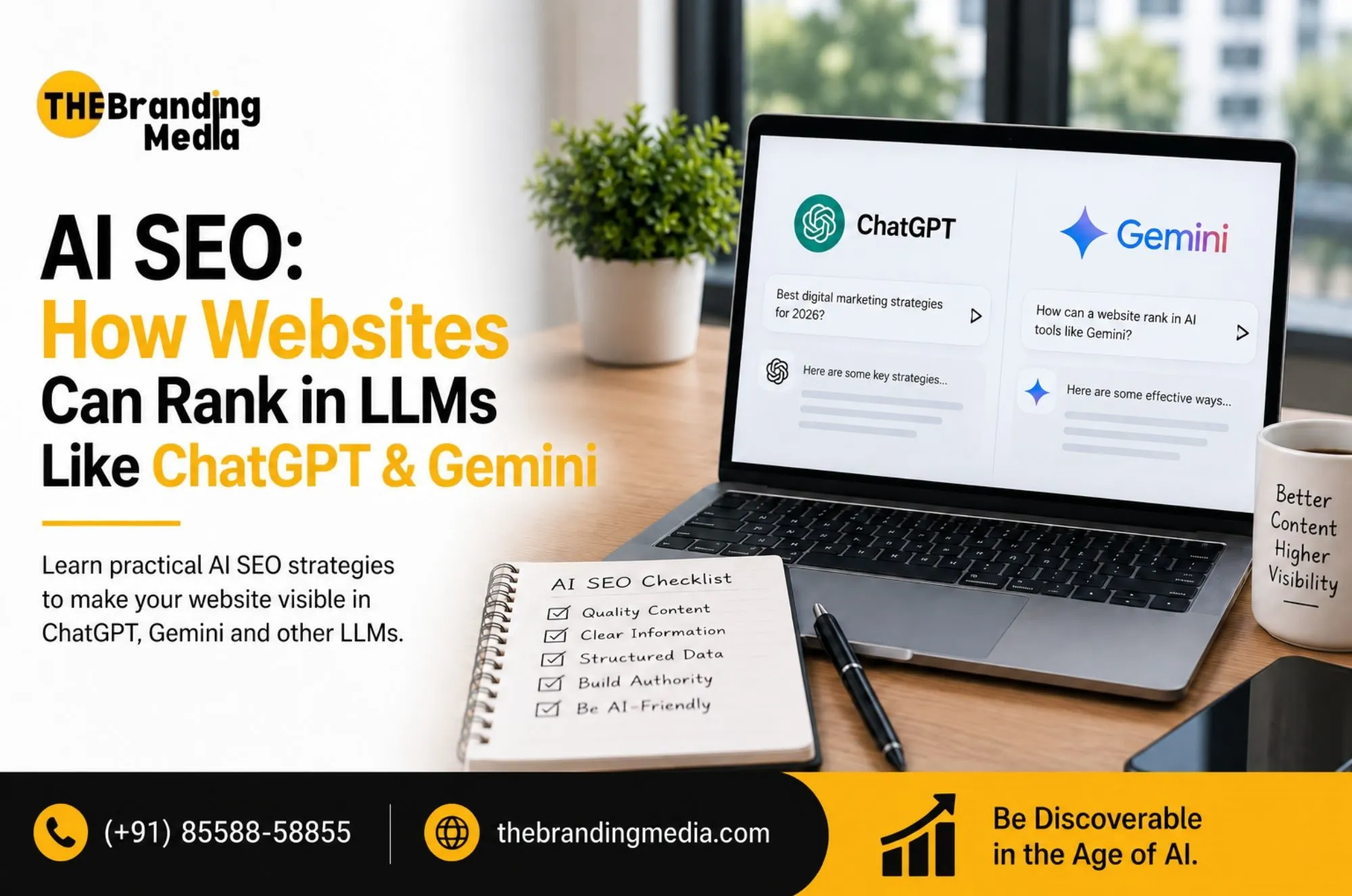
A person in Chandigarh recently asked ChatGPT the question “Which is the best digital marketing agency near me?” rather than searching for it on Google and receiving, within seconds, a direct answer including specific names. That is precisely the reason why AI SEO has now been developed.
The importance of being mentioned in that answer is just as great as it used to be for ranking on Google’s first page. This guide breaks down what AI SEO actually means, how tools like ChatGPT and Gemini decide who to mention, and what genuinely helps in 2026.
What Is AI SEO, Exactly?
AI SEO goes by a few names: Generative Engine Optimization (GEO), Answer Engine Optimization (AEO), or LLM optimization. The industry hasn’t settled on one term yet. All of them mean the same thing. It’s the practice of structuring your content so AI SEO tools cite, quote, or recommend your business when someone asks a relevant question.
Traditional SEO competes for a position in a list of links. AI SEO competes for a mention inside the actual answer itself, which is a genuinely different target. Zero-click searches already make up close to seven in ten queries today, based on recent industry tracking. Being cited by the AI is often more valuable now than ranking on page one ever was.
Google’s own 2026 guidance is refreshingly direct. It states that optimizing for its AI SEO features “is still SEO,” not some separate discipline you need to learn from scratch. Google’s AI Overviews alone now reach over two billion people every month, and ChatGPT serves hundreds of millions of users each week. Ignoring this shift isn’t really an option for any serious business anymore.
How AI Engines Actually Pick What to Cite
Here’s something most business owners don’t know. When someone asks an AI a question, it rarely searches for that exact sentence. Instead, it breaks the question into several smaller searches, a process called query fan-out.
A question about “best VPN for streaming in Europe” might quietly become three or four separate searches behind the scenes, each pulling in different sources. Other tools such as Perplexity and Google’s AI Overviews get up-to-date web information through a method known as retrieval, rather than relying solely on older training data.
As a result, well-organized new web pages can begin to appear in the answers rather suddenly, typically within a few days, not months. This is different from the way Google used to rank web pages and instead places a greater value on clarity than on keyword density.
Structure Your Content So AI Can Use It
AI SEO tools prefer content that is easy to extract and use within an answer. Instead they leave aside messy and unstructured pages and choose the clearer ones. A few practical changes help immediately:
- The core question must be addressed within the first two or three sentences.
- The heading should match the way the question is asked.
- Add FAQs and keep them precise and straightforward.
- Make it easy for the reader to pick out facts, prices, and other figures
Content that is doing well through organic SEO on Google also does well on AI answers because the criteria are quite similar. This shows why search engine optimization Chandigarh is so important in helping your content get found by Google and its AI answers.
Comparison-based content does especially well with this because AI needs to compare two or three different things before choosing which answer to provide.
Get Mentioned Beyond Your Own Website
AI-based search tools never rely on a single source. They pull results from many sources, such as review pages, review sites, forums, and directories. So your website alone can’t do everything; you also need to get listed on Google Business Profile and other review sites.
Having your name mentioned in comparison articles, local roundups, and industry publications builds the same kind of third-party trust that AI SEO tools consider before citing anyone.
AI-generated answers often mention websites such as Reddit and Quora as well, since the models tend to view genuine discussion threads as an indication of genuine, unfiltered opinions. Answers that are both authentic and helpful on such threads turn out to be more important than people anticipate.
Do You Need an llms.txt File?
You may have heard of llms.txt, a file that tells AI systems what to prioritize on your site. It sounds like a quick technical fix worth adding immediately. Here’s the honest reality for 2026. Google’s own guidance states plainly that llms.txt isn’t needed for AI Overviews or AI Mode, and most major AI crawlers don’t consistently use it for citations yet.
It genuinely helps AI coding agents reading developer documentation, the kind used by software teams, not local customers. For most local businesses chasing AI visibility, though, it currently isn’t the priority it’s often made out to be.
A more useful technical check is simply confirming your robots.txt file doesn’t accidentally block AI crawlers like GPTBot, ClaudeBot, or PerplexityBot from reading your site at all.
Keep Your Brand Details Consistent Everywhere
AI systems slowly create the so-called entity profile of your business by putting together all the references to it that are scattered around the web. This account is greatly confused by inconsistent details.
When your business name, address, or phone number differs on your website, in your Google Business Profile, and in the various directories, AI SEO tools are unable to confidently connect the information together.
It is the same NAP consistency principle which is already important for local SEO, but it is now even more significant. Having a clean and consistent online presence makes it much easier for AI to cite you with confidence rather than simply overlooking you out of caution.
Traditional SEO Still Matters
AI SEO doesn’t take the place of traditional SEO; instead, it is based on it and makes use of many of the same fundamentals that you have probably already dealt with. The fundamental foundation that AI SEO tools rely on when creating a response is strong technical SEO, real backlinks, and consistent local listings. Read More:
How to Check If AI Is Already Citing You
You don’t need expensive tools to find out where you currently stand. A simple manual test works well enough to start. Write down ten to fifteen questions real customers might genuinely ask. Run each one through ChatGPT, Gemini, and Perplexity a few times, since answers do vary between attempts.
Note whether your business appears, and in what context, then repeat this check every few weeks to track real movement over time. If you want to get a more automated view, you should set up individual tracking in Google Analytics for traffic that comes from ChatGPT, Perplexity, and Gemini. The trend you observe over a period of a few months will tell you much more than any single manual check ever could.
Should You Get Expert Help?
Keeping up with traditional rankings, Google updates, and AI visibility all at once is genuinely a lot for any single business owner to manage alone. This is exactly where a best SEO agency in Chandigarh earns its fee, by tracking both worlds at once instead of treating them separately.
The Branding Media already builds AI-readiness into its digital marketing services in Chandigarh, alongside the technical and local SEO fundamentals that still anchor everything else.
That typically means auditing your existing content structure, cleaning up entity signals across the web, and setting up the kind of AI-referral tracking most businesses never think to build themselves.
Frequently Asked Questions
Is the use of AI SEO fully replacing traditional SEO?
It’s far from the truth that AI optimization will replace SEO, because Google considers AI optimization a branch of SEO.
How long will it take to be cited by ChatGPT or Gemini?
Most businesses notice measurable results within four to eight weeks after real improvements have been made, although the outcomes will differ according to the particular query and the level of competition.
Do I really need an llms.txt file for my business?
Probably not yet. It mainly helps AI coding tools read developer documentation, not general business visibility inside AI answers.
Can small local businesses actually appear in AI answers?
Yes, especially for specific, local queries. Being mentioned consistently across Google, directories, and review sites meaningfully improves your odds.
How is this different from just doing good local SEO?
It largely isn’t, at the foundation. AI SEO adds a layer focused on structure, citations, and third-party mentions on top of solid local SEO work.
Which AI platform should I focus on first?
Start with whichever tool your customers likely already use, usually ChatGPT or Google’s AI Overviews. Track results there before expanding to Perplexity and Gemini.
Ready to Show Up in AI Answers Too?
AI search isn’t a future trend anymore. It’s already changing how customers in Chandigarh find businesses like yours today. The businesses that adapt early will be the ones customers actually hear about, while the rest quietly become harder and harder to find.
Start by testing a few real customer questions in ChatGPT or Gemini this week, and see exactly where you currently stand. Have questions about your specific website? Drop them in the comments, or talk to The Branding Media for a free AI-readiness check.